OrgFaces
Build and visualize company org charts in minutes. OrgFaces turns team structure, roles, and hierarchy into a clear, collaborative visual — built for growing companies.
Visit the site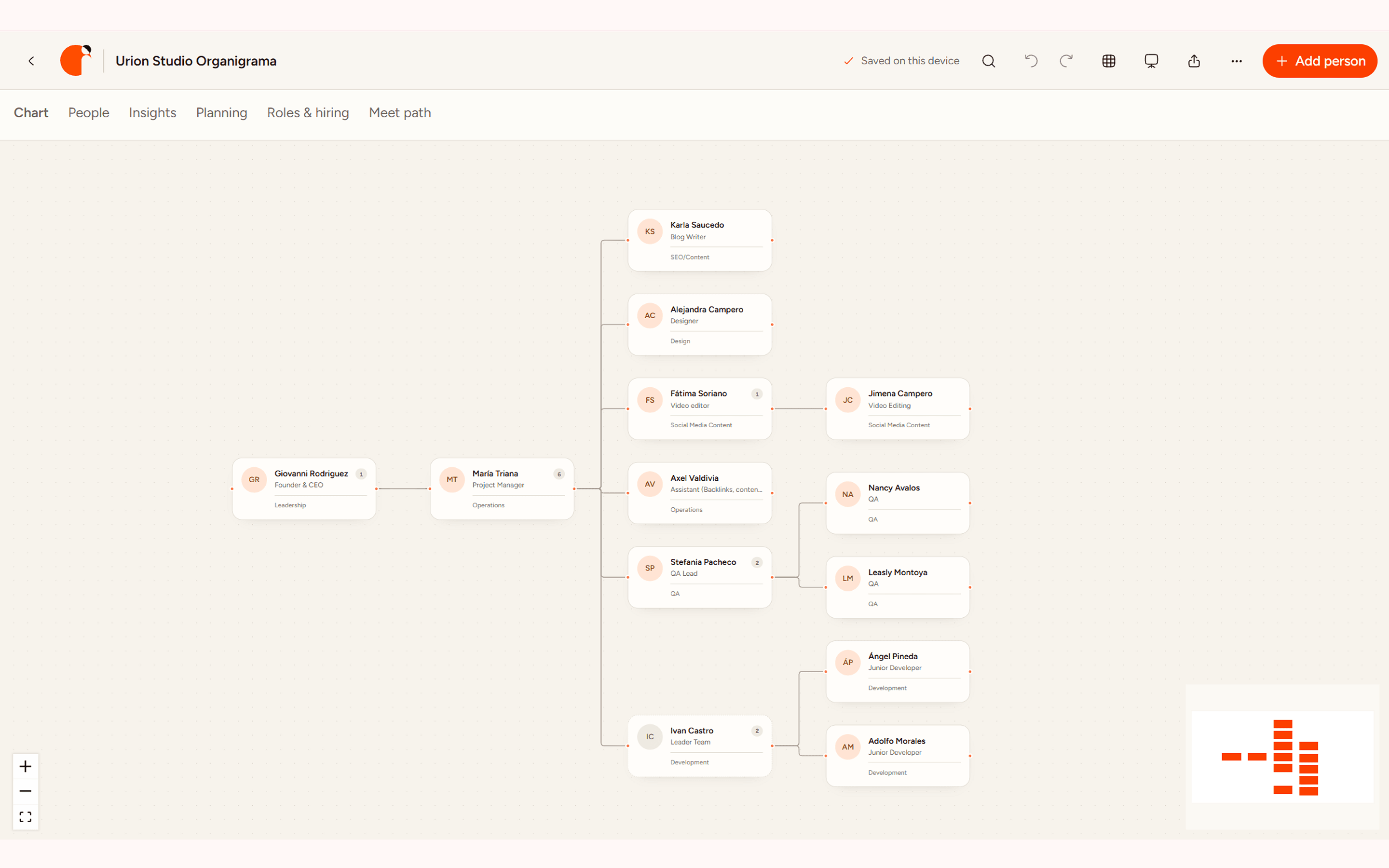
OrgFaces lets growing companies map out teams, roles, and reporting lines in minutes instead of hours in a spreadsheet or slide deck.
The Challenge
As companies grow past a handful of people, nobody has a clear picture of who reports to whom, which roles are open, and where a team is stretched thin. That picture usually lives in someone’s head, a stale slide from six months ago, or a tangle of boxes and lines in a generic diagramming tool that was never built for org structure. HR and leadership needed a way to build, update, and share an org chart without fighting a general-purpose drawing tool every time someone changes teams.
What We Built
A focused, visual org-chart builder designed around how teams actually change over time:
- Drag-and-drop hierarchy builder — add people, assign roles, and reshape reporting lines directly on the chart
- Role and team structuring — group people into teams and departments, with reporting lines that update automatically as the structure changes
- Collaborative editing — HR and managers work from the same live chart instead of passing around exported images
- Instant visual clarity — headcount, open roles, and reporting gaps are visible at a glance instead of buried in a spreadsheet
- Fast setup — a new org chart goes from blank canvas to a usable structure in minutes, not a multi-day HR project
Technical Approach
OrgFaces is a web application built around a hierarchical data model where every person node carries a role, a team, and a single reporting line, keeping the chart mathematically consistent as people move between teams or managers. The rendering layer draws the chart as an interactive tree, recalculating layout in real time as nodes are added, removed, or reassigned, so the chart never falls out of sync with the underlying structure.
Edits are applied directly to the shared data model rather than to a static image, which is what makes the chart collaborative — every change is immediately reflected for anyone viewing that org.
Architecture Decisions
We treated the org chart as structured data first and a diagram second. That decision is what enables features a generic drawing tool can’t offer: reassigning someone’s manager automatically redraws every line beneath them, and restructuring a team doesn’t mean manually dragging a dozen boxes around a canvas.
Keeping the data model simple — person, role, team, manager — was a deliberate tradeoff. It covers the vast majority of real org structures cleanly, and it’s what keeps the tool fast and easy to learn instead of turning into another heavyweight HR platform.
Results
OrgFaces gives growing companies a single, always-current source of truth for team structure — one that HR, managers, and leadership can all read and edit without training or a dedicated admin. What used to be a static, quickly outdated artifact becomes a living document that keeps pace with how fast the team actually changes.